
"Provisions on the Administration of Investment in the Automobile Industry" issued Do new car-making forces still have their own qualifications?
Release time:
2018-12-24
However, what changes have been made to the new policy compared to the solicitation draft? What is the decision-making thinking reflected behind it? For new car manufacturers, which of the three methods is more cost-effective: borrowing a shell, buying a shell, or building a shell? How will the new policies in the future affect the development of the domestic automotive industry? Let's analyze it in detail.


Image from "Yiou Net"
Just the day after Chehejia spent 6 million yuan to purchase car manufacturing qualifications, the National Development and Reform Commission issued the "Regulations on the Administration of Investment in the Automotive Industry", and the approval requirements for car manufacturing qualifications have undergone new changes, so the topic of whether buying qualifications is worth it has also aroused heated discussions. In fact, the "Provisions on the Administration of Investment in the Automotive Industry" and the "Measures for the Administration of Access to Road Motor Vehicle Manufacturers and Products" issued by the Ministry of Industry and Information Technology not long ago constitute two new "gates" for the access of the automotive industry.
However, what are the changes between the new policy and the exposure draft? What about the thinking of the decision-making level behind it? For new car manufacturers, which of the three ways of backdoor borrowing, shell buying and shell manufacturing is more cost-effective? How will the new policy affect the development of the domestic auto industry in the future? Let's break it down in detail.
Overall situation: affirmation of achievements, strict control of production capacity
Automobile is a typical pillar industry integrating labor-intensive, technology-intensive and capital-intensive, and at the same time it is related to road safety and the vital interests of the people. Therefore, the development of the automobile industry in China has always been in a strict control situation to ensure the standardized development of the industry.

There are many means of strict control, involving front-end, mid-end, back-end and other levels. At the front-end production level, China has implemented the NDRC's automobile investment approval and the Ministry of Industry and Information Technology's enterprise/product access two-door and three-lock restriction policy for many consecutive years. To put it simply, the National Development and Reform Commission (and even the State Council) is responsible for the investment approval of major automobile projects, and only after the approval is passed can the construction of production bases be justified; After the completion of the production base, the Ministry of Industry and Information Technology shall conduct an audit in accordance with the enterprise and product access standards, and after the review is passed, the products produced by the enterprise can be listed in the announcement catalog, listed for sale and licensed.
Once an enterprise passes these two doors and three locks, it means that there is a formal "dual qualification ID card", which is commonly known as the "shell" in the industry. The Regulations on the Administration of Investment in the Automotive Industry, adopted by the National Development and Reform Commission on December 12, govern the first "shell".
Previously, the industry's attitude towards the "shell" had its own views and even many derogatory words, but objectively speaking, the strict management of the "shell" itself is not wrong, and the scarcity of resources caused by the strict management of the "shell" is also logical.

It can be seen from the above table that under the background of capital profit and industrial transformation, a large number of resources have rushed into the field of new energy vehicles. However, we believe that emerging forces generally do not have complete car-making strength, and serious overcapacity and disorderly development of low-end production capacity must be eliminated. From this point of view, the new investment management management and production qualification access once again build a higher threshold, which is not only necessary for the healthy development of the industry in the next stage, but also has more benefits than disadvantages.
Contrast between old and new: more reasonable, clearer, stricter
After talking about the overall significance, let's talk about the main differences and changes between the new policy and the draft for comments, as well as the thinking of the decision-makers when adjusting the details.
First, the decentralization of authority is even stronger. In the consultation draft, for the first time, the authority for automobile investment has been decentralized (from the central to the local level), and the National Development and Reform Commission is basically no longer responsible for specific approvals, but instead has local filing. In the official document, the authority is still fully decentralized, but it only stipulates that the investment projects of finished vehicles shall be recorded and managed by the provincial development and reform department, and there will be no more level constraints on other projects such as special vehicles.
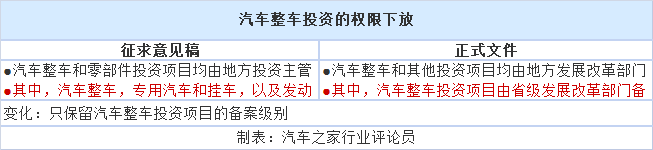
This change reflects the macro-management idea of further increasing the intensity of "decentralization, management and service" at the decision-making level, abandoning other categories that do not occupy the dominant position, and realizing a greater degree of "simplification and decentralization".
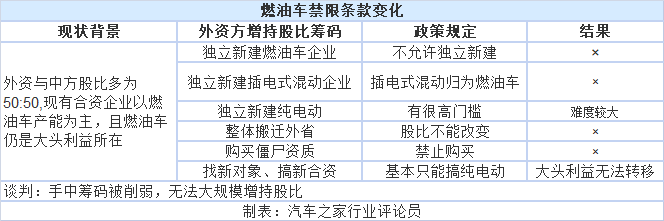
Second, the rules for prohibiting the construction of traditional fuel vehicles are more reasonable, effectively hedging the threat caused by the opening of the stock ratio. In addition to prohibiting the establishment of new independent fuel vehicle enterprises, the official document also adds the conditions for relocation, that is, the overall relocation is allowed without changing the equity structure of the enterprise; At the same time, the definition of zombie enterprises is more rigorous, and the inclusion in the enterprise directory specially announced by the Ministry of Industry and Information Technology is used as a precise definition condition to avoid disputes of opinion.
The change of the prohibition clause of fuel vehicles is the most noteworthy aspect of this official document, because it effectively weakens the bargaining power of foreign investors in the negotiation of share ratio liberalization by classifying plug-in hybrids into the category of fuel vehicles, prohibiting the establishment of new independent enterprises, setting equity constraints for relocation, and tightening the acquisition conditions of zombie enterprises, and avoiding the phenomenon of large-scale foreign equity increase.
Third, the conditions for fuel vehicle capacity expansion are appropriately relaxed. In the new policy, two major changes have been made to the conditions for the expansion of fuel vehicles, firstly, the definition of capacity utilization rate is clearer, divided into two categories: passenger cars and commercial vehicles, which are also more in line with the actual situation of their respective industries; The latter is to transfer the actual indicator of the proportion of exports to a virtual indicator that the product is internationally competitive.
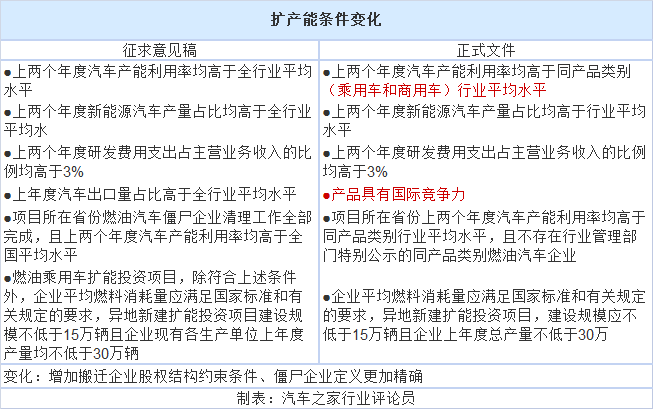
This change reflects the feedback received by decision-makers after the release of the consultation draft, and it was generally believed that the conditions for capacity expansion were too stringent, so the NDRC took discretion and appropriately lowered the threshold.

Fourth, plug-in hybrid capacity expansion is not constrained by the proportion of output and region. In the new policy, plug-in hybrid specifically proposes two exemptions: respectively, the exemption of the production ratio requirements of the previous two years and the requirements of the province where the project is located, which is more relaxed than that of fuel vehicles.

This change came after the release of the draft for comments, and some voices in the industry pointed out: "The laggard party of new energy vehicles (including car companies and localities) should have increased its development efforts and responded to the call of the central government, and further restrictions will aggravate the backward status quo." This opinion should be recognized by the decision-making level, so the constraints of the status quo are broken, and the role of policy promotion and encouragement is realized.
Fifth, encourage mergers and acquisitions, encourage internal allocation and digestion of excess production capacity. Articles 15 and 16 of the new policy make special provisions on mergers and acquisitions and internal deployment, and give the green light to mergers into non-independent enterprises, intra-group allocation and capacity expansion, and intra-provincial allocation and expansion.
This change in decision-making reflects that the new policy is not only deliberately inhibiting the excessive increase of new production capacity, but also raising the digestion and integration of existing production capacity to a certain height, and achieving the overall balance and structural optimization of production capacity through the simultaneous efforts of the old and new ends.
Sixth, the regional assessment of new pure electric projects is more reasonable. In the consultation draft, the regional requirements for new pure electric vehicles are more related to the application side (ownership, infrastructure), while the official document focuses on the production side, emphasizing the progress of production and construction and the actual use of production capacity.
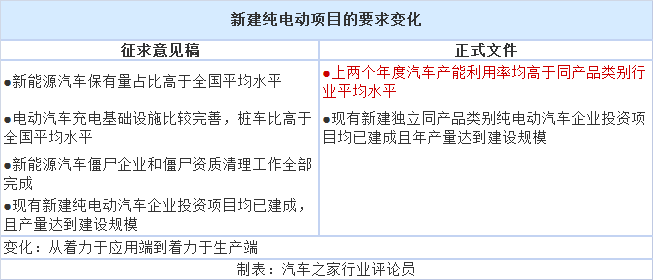
This change is very correct, because it is a new pure electric production capacity, so in order to meet the guidance goal of industrial agglomeration, it should make a "depression" effect in the area with a good production base, and the production end and the application end cannot be essentially equivalent, and it is reasonable to remove the assessment of the application side.
Seventh, the shareholders' clauses have been further tightened to prevent capital from escaping and profiting. In the new policy, it not only adheres to the conditions for shareholders to withdraw capital, but also puts forward new requirements for enterprises where "design and development enterprises, overseas enterprises and other market entities are the main corporate shareholders", that is, the product must be pure electric, and the mileage is changed to the sales amount. The amount of sales, in particular, keeps most other classes of shareholders out.
This change highlights the extreme disgust of decision-makers with the "subsidy profit model" and "qualification profit model" that are common and common among the new car manufacturers. Specifically, the subsidy profit model is that some shareholders take subsidy dividends through products, while the qualification profit model is that some shareholders receive subsidy dividends through smaller costs (angel round - round A - round B ... step-by-step arbitrage) to obtain the "additional profit" brought by the qualification.
Eighth, the expansion of pure electric production capacity in different places must have a starting order. In the new policy, there are independent constraints on the expansion of pure electric production capacity in different places: "no less than 10,5000 passenger cars and no less than 10,5000 commercial vehicles". In other words, the requirements for off-site expansion and new construction are the same, starting from <>,<> and <>,<> vehicles, achieving a bowl of horizontal ends.
This change effectively closes the loophole in the draft clause, that is, some enterprises may consider acquiring new factories in the form of new factories in different places when they cannot seek to build new buildings, and new factories can make smaller production capacity and then profit through land, government subsidies and other forms.
The ninth is to update the specific management regulations for parts and components projects. Mainly for the manufacture of engines, power batteries, fuel cell stacks, vehicle bodies and other key components to update some technical terms, cancel some unreasonable indicators, add some assessment of R & D strength and other aspects. This aspect will not be introduced one by one, you can query and compare by yourself.
Main impact: Both products and participants are affected
The author analyzes that after the introduction of the new policy, the industry will be affected and fluctuated by the following in terms of both products and participants:
In terms of products, the gap between strength and weakness in the field of fuel vehicles has further increased. Since the new production capacity of fuel vehicles will be concentrated in leading companies or large groups, the originally backward car companies cannot achieve expansion through new construction and expansion (even if they barely meet the standard, the threshold for capacity expansion is more than 15,<> vehicles, which is extremely stressful for small and medium-sized enterprises), resulting in a further widening gap between the two.
The difficulty of capacity expansion of plug-in hybrid passenger cars is greater than that of pure electric, and the main strategy of pure electric drive is guaranteed. Since plug-in hybrid passenger vehicles are higher than pure electric in terms of R&D proportion, enterprise CAFC value, and construction scale, and plug-in hybrid itself is technically more difficult than pure electric, companies will be more inclined to pure electric capacity expansion when choosing, which will ensure the continuation of the main strategy of pure electric drive after 2020 to a certain extent.
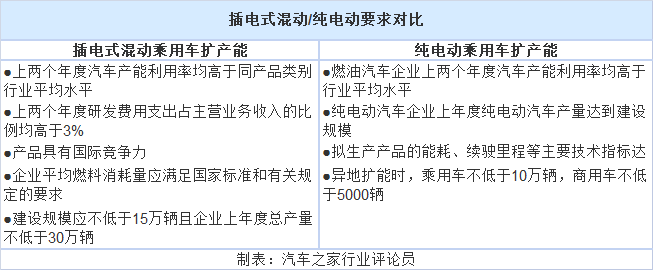
Plug-in hybrid passenger cars will be positioned in both project investment and double credit policies. As mentioned earlier, plug-in hybrids are included in the project investment policy because of the liberalization of the equity ratio, but there should be no doubt about their status as "new energy vehicles" in the double credit policy, and the corresponding NEV point calculation standards will still be implemented, and there is no need to care about their kicking out of the new energy vehicle sequence. At the same time, due to the suppression of low-end production capacity, the gold content of new energy vehicle credits has also been improved, which is worthy of recognition.
In terms of participants, the new forces that have not yet entered have been dealt a heavy blow and their interest is difficult to repeat. Traditional cars are too difficult, new pure electric vehicles face high threshold constraints, coupled with the policy on the exit of equity capital made strict regulations, so it is difficult for the new forces that have not yet entered to maintain their previous enthusiasm for holding new energy vehicle investment qualifications, the only way is to find an enterprise OEM, meet the conditions and then apply for new construction, but the time is too long capital is difficult to wait, so the industry capital heat will decline to a certain extent.
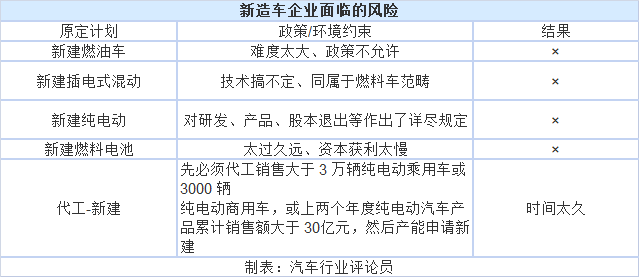
New automakers that have obtained qualifications have a first-mover advantage. There is no doubt that companies that have obtained qualifications can avoid the long qualification preparation cycle and achieve faster product market launches, so this type of new car manufacturers have a first-mover advantage over companies that have not yet entered. In addition, because the Ministry of Industry and Information Technology approved the legalization of OEM and the NDRC is also vigorously suppressing qualification trading, the transaction price of qualifications is bound to decline.
The industry will be divided into three genres: backdoor, backdoor and shell making. For enterprises that do not have qualifications at all and do not want to invest money for qualifications, they will further turn to OEM production, that is, backdoor borrowing; For enterprises that have time constraints on the capital side or intend to launch their products as soon as possible, they will increase their efforts to find a way to buy shells, and in order to avoid the constraints of the NDRC's investment project terms, enterprises will prefer to directly purchase the production qualifications of the Ministry of Industry and Information Technology; For long-term and gradual enterprises, self-construction and qualification application will become the main way, that is, shell making. All three shells can complete the product launch, and are also suitable for different enterprise status, but the author believes that in the long run, if enterprises want to become bigger and stronger, they should still take the road of shell building.

Foreign brands will shift to plug-in hybrid and pure electric walking on two legs. Foreign brands previously preferred the plug-in hybrid technology route, but after the introduction of the new investment policy, whether it is new construction or capacity expansion, plug-in hybrid has been suppressed to a certain extent, so foreign brands will gradually change from plug-in hybrid to plug-in hybrid/pure electric balance, and the speed of pure electric products will be accelerated.
Chinese brands will receive another five-year dividend period, but they should seize the opportunity to strengthen their strength. Although the investment new policy gives certain protection to Chinese brands, but according to the law of policy changes this period is not too long, five years after the international environment will undergo new changes, whether there will be new policies to introduce is difficult to say, so this last five-year dividend period to firmly grasp, Chinese brands should seize the time to practice internal skills, enhance their strength and right to speak, otherwise the stock ratio is really no bargaining power to open up negotiations.
There are questions and suggestions
The new policy generally listened to a lot of industry feedback and made adjustments to unreasonable places, but there are still some small places that are not reasonable.
New / expanded power batteries cannot lack safety assessments. The importance of electric vehicle safety does not need to be repeated, and the safety performance of power batteries is the top priority, and the draft for comments specifically designs safety assessment indicators, requiring that no safety accidents can occur within the specified time, but it is directly deleted in the official document. It is true that power battery safety accidents should be treated separately, but at least the assessment of production safety accidents should be retained, which is the biggest deficiency in the new policy.
Finally, the author would like to say that no matter how the policy changes, the concept of standardized development of the enterprise itself is more effective than any policy constraint, and the enterprise standard exceeds the national standard, so that the enterprise truly has a future, and our automobile industry can truly embrace the future.
Related News
Jiangmen Xingjiang Steering Gear Co., Ltd. is a specialized high-tech enterprise that produces automotive power steering gear, a member of the China Association of Automobile Manufacturers, and a chairman unit of the Steering Gear Committee of the China Association of Automobile Manufacturers.
CONTACT US
Add: No. 465, Xihuan Road, Pengjiang District, Jiangmen, Guangdong, China.
Fax:+86-750-2632612